🔬 Introducing the “Zero-Cell” Universal Constructor: Minimalist Self-Replication
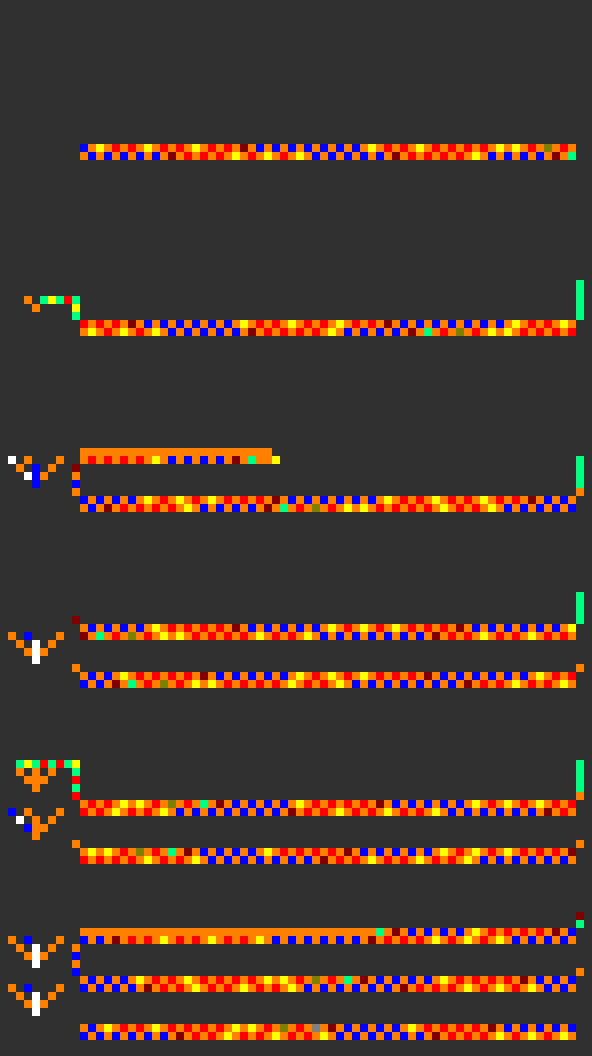
For decades, the standard for computational self-replication has been defined by complex architectures—machines that require a large, permanent “body” to decode their own genetic tape. Today, we announce the successful development of a new paradigm: the “Zero-Cell” Universal Constructor (ZC-UC).
This achievement represents a fundamental simplification in the field of cellular automata (CA), proving that universal construction does not require a complex, static control unit.
The Core Claim: Zero-Residue Universality
The ZC-UC is a cellular automaton designed to operate within an expanded rule-set that contains the Turing-complete Wireworld CA as a functional subset (the payload).
Our central claim formalizes the Transient-Body architecture:
The “Zero-Cell” Universal Constructor (ZC-UC) is a self-replicating cellular automaton that can construct an arbitrary, Turing-complete pattern (the Wireworld payload) while leaving a zero-cell residue of non-payload, non-tape components in its final state.
This means that the complex mechanism used to read the tape, move, and deposit cells (the Construction Arm) is entirely self-annihilating, leaving behind only the machine’s permanent components: the genetic tape and the new payload.
The Quadruple Simplification
The ZC-UC does not merely shift complexity; it achieves a holistic reduction across the most critical metrics used to measure CA complexity:
| Metric | ZC-UC Value | Significance |
|---|---|---|
| Permanent Control Cells | 0 | Spatial Simplicity. Eliminates the complex, static “body” required by all classic Universal Constructors. |
| Number of States | 15 | Rule Simplicity. Achieves universal construction with a highly minimalist set of local transition rules. |
| Genetic Tape Length | 124 units | Program Efficiency. Requires an exceptionally concise program to encode construction, self-replication, and annihilation. |
| Replication Period | 252 steps | Temporal Efficiency. Completes a full construction and self-annihilation cycle in a remarkably short time. |
By successfully minimizing complexity in these four independent dimensions, the ZC-UC demonstrates a new frontier for elegant, efficient, and minimalist self-organization in artificial life.
This prototype is now fully realized and functionally verified. We look forward to presenting the full formal rule set and proofs in upcoming academic venues.