The Woven Transformation: Forcing Global Parity in Aperiodic Tilings
Theory
For any aperiodic tileset $T$ with even-vertex coordination and a valid substitution rule, there exists a companion tileset $T’$ that is non-MLD (Mutually Locally Derivable) to $T$. I call this the Woven Transformation.
Demonstration with Penrose P3
 |
|---|
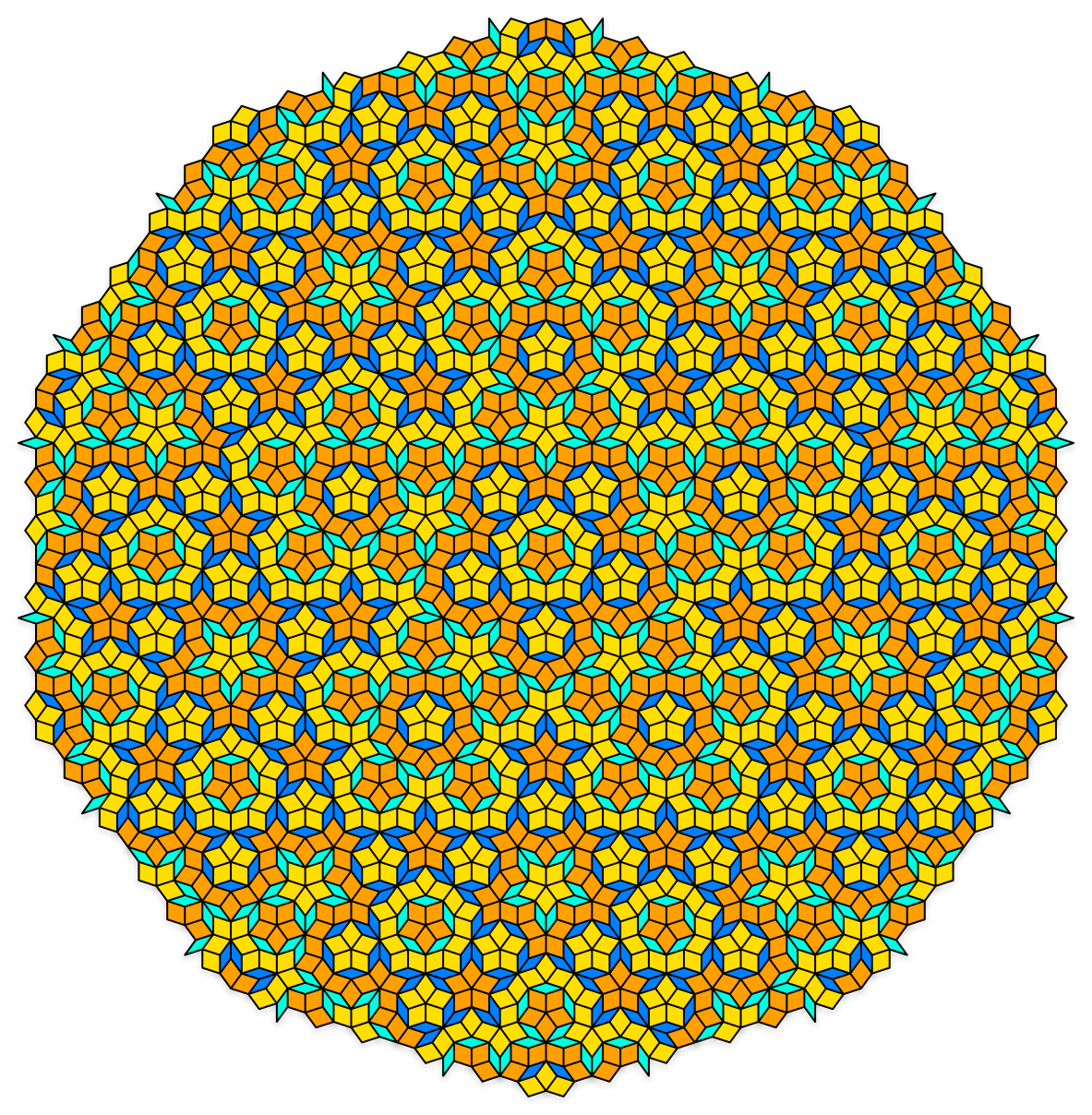
| Patch. The patch shows the tiling after the woven transformation has been applied. Note how each of the rhomb shapes appears in two colors across the tiling. |
 |
|---|
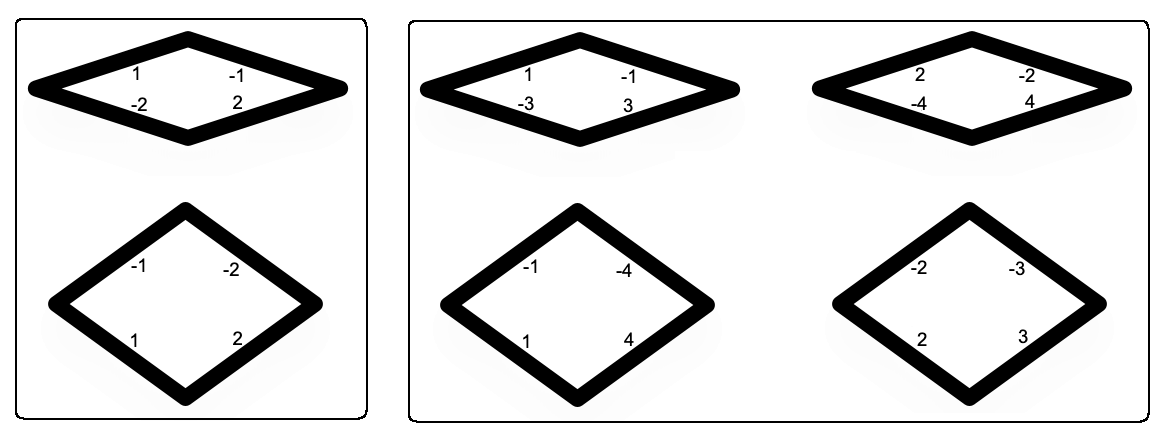
| Tilesets. This image shows the tilesets before (left) and after the woven transformation (right). The matching rule is that integers on either side of an edge must sum to zero. |
Note that the original P3 is “phase-blind”. By injecting a bipartite parity, we only need to “flip” the markings on one pair of tile types to force the global phase.
Is it really non-MLD? Yes. A local observer can see the tiles, but they cannot see the parity. To determine the $L/R$ state of a single tile, you must know its relationship to the global inflation seed. Because this information cannot be derived from any finite local patch, $T$ and $T’$ are non-MLD.
Comments welcome. Particularly regarding the non-MLD status of the Woven tiling, and originality of the theory.